Research project / 2026

VideoRAE Taming Video Foundation Models for Generative Modeling via Representation Autoencoders

Compact, generation-friendly video latents from frozen Video Foundation Models — supporting both continuous DiT and discrete AR generators with faster convergence.

Zhihao Xie1,2,*, Junfeng Wu2,*, Xinting Hu4, Junchao Huang1,3, Li Jiang1,3,†

1CUHK-Shenzhen 2HUST 3Shenzhen Loop Area Institute 4USTC

*Equal contribution. Corresponding author.

Text-to-video generation 5× faster convergence Continuous & discrete latents
Text-to-video samples playing live Scroll to explore

Video

Introducing VideoRAE

An overview of the method, results, and video generation demos.

Abstract

Compress frozen VFM features into compact continuous and discrete latents for video generation.

Backbones
V-JEPA 2 V-JEPA 2.1 VideoMAEv2
Latent spaces
Discrete Continuous
Downstream
Text-to-Video Class-to-Video

The rapid advancement of video generative modeling has been largely driven by diffusion and autoregressive models operating in the latent spaces of 3D Variational Autoencoders (3D-VAEs). However, conventional 3D-VAEs are mainly optimized for pixel-level reconstruction, and this objective often limits the semantic and spatio-temporal structure captured by their latent spaces, constraining downstream synthesis quality. Concurrently, Video Foundation Models (VFMs) such as V-JEPA 2 and VideoMAEv2 have demonstrated exceptional semantic understanding capabilities. Yet, whether such frozen video foundation representations can be transformed into compact, reconstruction-capable, and generation-friendly video latents remains largely unexplored. In this work, we answer this question affirmatively with VideoRAE. VideoRAE leverages multi-scale hierarchical features from a frozen video foundation encoder and employs a lightweight 1D self-attention projector to compress them into a highly compact latent space. The resulting latents support both continuous representations for Diffusion Transformers (DiTs) and discrete representations for autoregressive models via multi-codebook high-dimensional quantization. During decoding, VideoRAE incorporates a local-and-global representation alignment objective with the frozen VFM teacher, which improves semantic preservation and enables training without KL regularization. Comprehensive experiments show that VideoRAE achieves strong reconstruction in both continuous and discrete regimes. On UCF-101, it achieves state-of-the-art class-to-video gFVDs of 40 and 93 with AR and DiT generators, respectively, while converging approximately 5× faster than competing autoencoder baselines. In a controlled 2B-scale text-to-video experiment, replacing LTX-VAE with VideoRAE leads to faster convergence and consistently better VBench performance. These results validate frozen VFM representations as versatile and generation-friendly video latents. The model and code will be released.

Method

How VideoRAE builds generation-ready latents.

  1. 01

    Frozen VFM features

    Extract multi-scale hierarchical features from a frozen video foundation encoder and fuse them.

  2. 02

    Compact latents

    Compress with a 1D self-attention projector into continuous DiT latents or discrete AR tokens.

  3. 03

    Align & decode

    Align decoder features with the VFM teacher at local and global scales to preserve semantics.

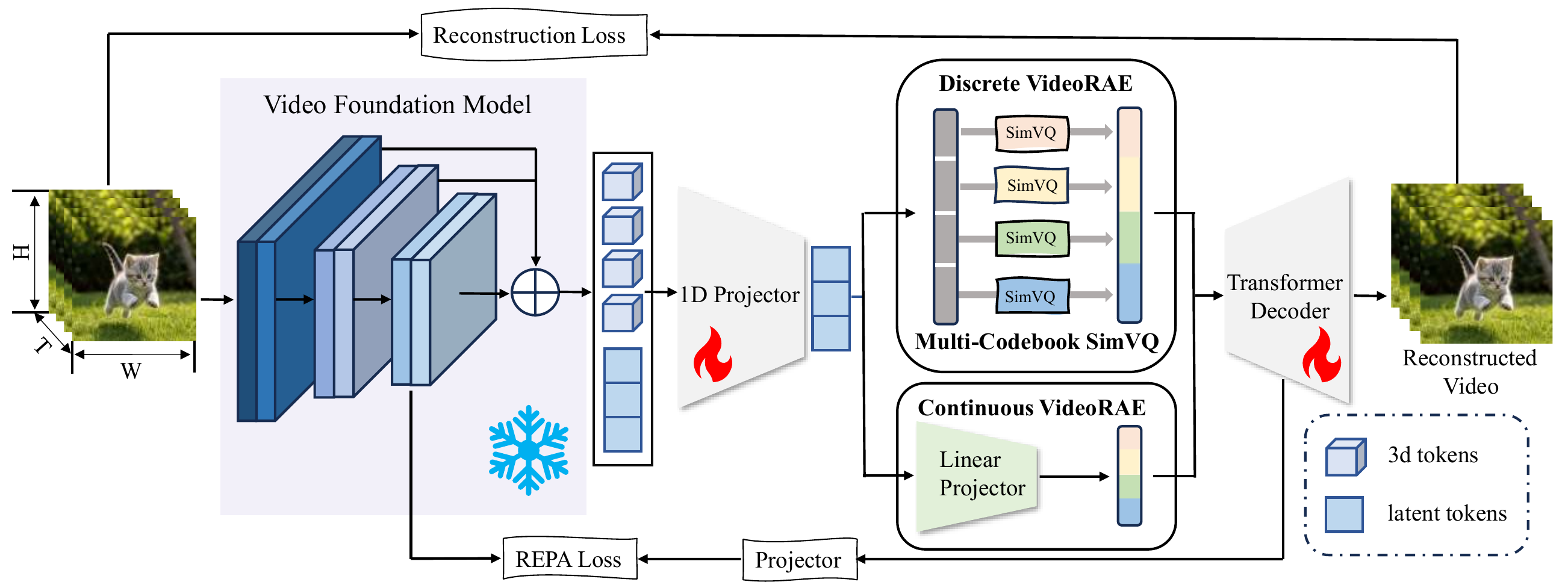
Overall architecture of VideoRAE.

Given an input video, multi-scale hierarchical features are first extracted from a frozen VFM and fused, followed by a 1D self-attention projector that dynamically compresses them into compact base tokens. These tokens are then formatted into either a continuous latent space via linear projection for Diffusion Transformers, or a discrete latent space via Multi-Codebook SimVQ for Autoregressive models. Finally, during decoding, the Representation Alignment module explicitly aligns intermediate decoder features with the VFM teacher at both local and global scales, intrinsically regularizing the semantic structure of the latent manifold.

Evaluation

Experimental Results

40

AR gFVD on UCF-101

State-of-the-art discrete generation

93

DiT gFVD on UCF-101

State-of-the-art continuous generation

Faster convergence

vs. competing autoencoder baselines

Reconstruction

VideoRAE delivers strong reconstruction in both continuous and discrete regimes, preserving fine spatial details and temporal consistency under a highly compact latent budget.

Table 1. Reconstruction performance of discrete tokenizers on UCF-101 and TokenBench.

VideoRAE (VideoMAEv2) VideoRAE (V-JEPA 2) VideoRAE (V-JEPA 2.1)
Method #rToken UCF-101 TokenBench-256×256
PSNR↑LPIPS↓rFVD↓ PSNR↑LPIPS↓rFVD↓
AR generative models with discrete video tokenizers
TATS1024162
OmniTokenizer512029.250.112825.550.1144
LARP-L-Long102427.880.123528.650.1145
SweetTok128029.270.0720
VideoRAE (VideoMAEv2)102429.940.101630.690.0933
VideoRAE (V-JEPA 2)102429.390.101329.930.1028

Table 2. Reconstruction performance of continuous autoencoders on UCF-101 and TokenBench.

Method Config UCF-101 TokenBench-256×256
PSNR↑LPIPS↓rFVD↓ PSNR↑LPIPS↓rFVD↓
Diffusion generative models with continuous video tokenizers
CV-VAE4096×430.110.125730.800.1161
LTX-VAE128×12832.020.103533.740.0832
LTX2128×12828.880.121529.360.1136
LeanVAE4096×430.990.111031.790.1023
VideoRAE (VideoMAEv2)512×3231.230.081332.060.0825
VideoRAE (V-JEPA 2)512×3230.400.091431.190.0925
CogVideoX-VAE4096×1636.220.05736.350.049
WAN2.1-VAE4096×1635.700.05437.020.046
VideoRAE (VideoMAEv2)1024×6433.640.06534.250.0711
VideoRAE (V-JEPA 2)1024×6432.140.07732.560.0813

Table 3. Reconstruction performance of 3D projector variants on UCF-101 and TokenBench.

Method Config UCF-101 TokenBench-256×256
PSNR↑LPIPS↓rFVD↓ PSNR↑LPIPS↓rFVD↓
VideoRAE-3d (VideoMAEv2)1024×6433.500.06534.070.0712
VideoRAE-3d (V-JEPA 2)1024×6431.910.07732.480.0815
VideoRAE-3d (V-JEPA 2.1)1024×6431.880.07732.190.0716

Generation

On UCF-101 class-to-video generation, VideoRAE reaches state-of-the-art gFVDs of 40 (AR) and 93 (DiT), outperforming competing autoencoder baselines under matched generator settings.

Table 4. Class-conditional generation evaluation (Discrete AR) on UCF-101, evaluated on 10K generated samples.

Tokenizer Resolution #Tokens #Params gFVD↓
CogVideo (Hong et al., 2022)256×25668009.4B626
TATS (Ge et al., 2022)256×2564096321M332
Video-LaVIT (Jin et al., 2024)256×2565127B280
OmniTokenizer (Wang et al., 2024b)256×2565120650M191
LARP-L (Wang et al., 2024a)256×2561024632M99
SweetTok (Tan et al., 2025)256×2561280650M84
SweetTok (Tan et al., 2025)256×25612801.9B65
VideoRAE (VideoMAEv2)224×22410241.3B45
VideoRAE (V-JEPA 2)256×25610241.3B40

Table 5. Class-conditional generation evaluation (Continuous DiT) on UCF-101, evaluated on 2K generated samples.

Method Resolution Configs gFVD↓
Latte (Ma et al., 2024)256×2564096×4478
LeanVAE (Cheng & Yuan, 2025)256×2564096×4164
LTX-VAE (HaCohen et al., 2024)256×256128×128161
VideoRAE (VideoMAEv2)224×224512×3299
VideoRAE (V-JEPA 2)256×256512×3293
WF-VAE (Li et al., 2025)256×2564096×16371
LeanVAE (Cheng & Yuan, 2025)256×2564096×16175
DeCo-VAE (Yin et al., 2025)256×2564096×16166
CogVideoX-VAE (Yang et al., 2025)256×2564096×16151
WAN2.1-VAE (Wan et al., 2025)256×2564096×16126
VideoRAE (VideoMAEv2)224×2241024×64103
VideoRAE (V-JEPA 2)256×2561024×6494

Table 6. Class-conditional generation evaluation (3D projector variants) on UCF-101, evaluated on 2K generated samples.

Method Resolution Configs gFVD↓
VideoRAE-3d (VideoMAEv2)224×2241024×64104
VideoRAE-3d (V-JEPA 2)256×2561024×6496
VideoRAE-3d (V-JEPA 2.1)256×2561024×6493

Class-to-Video Convergence

VideoRAE converges approximately faster than LTX-Video on class-to-video generation, matching baseline quality in far fewer training epochs for both AR and DiT settings.

Class-to-video AR convergence comparison.
AR
Class-to-video DiT convergence comparison.
DiT

Text-to-Video Convergence (VBench)

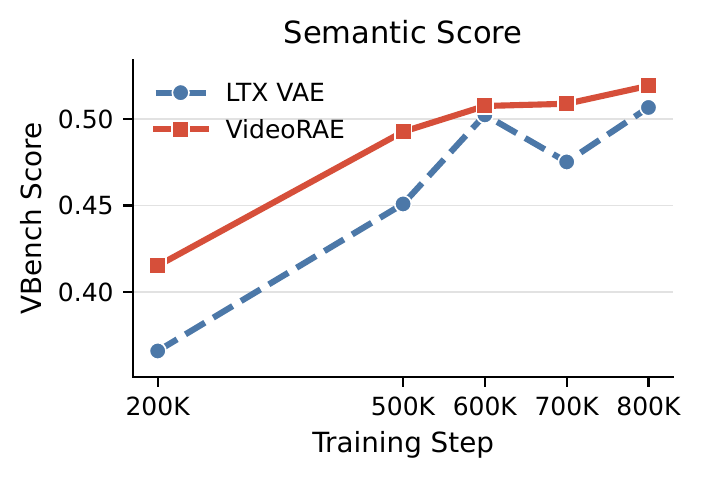
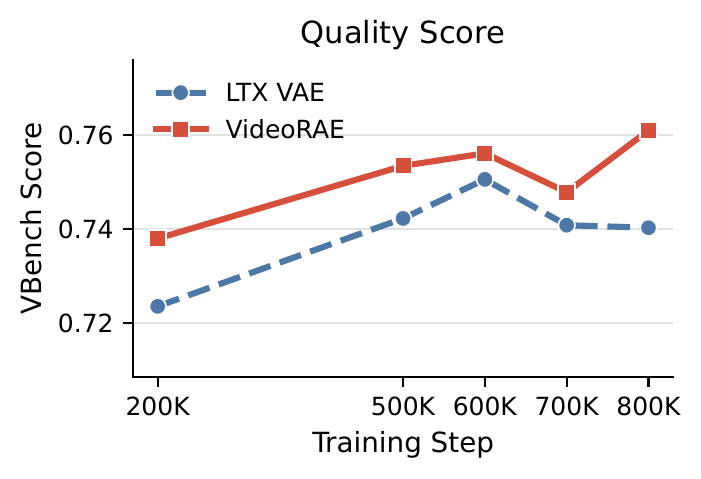
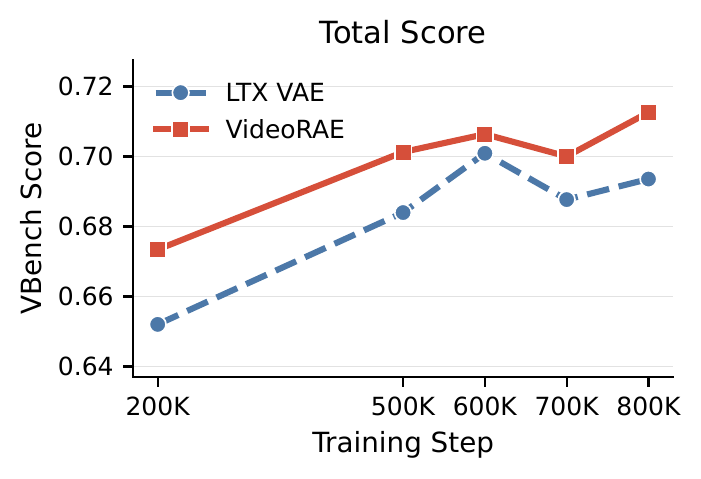
In a controlled 2B-scale text-to-video setting, replacing LTX-VAE with VideoRAE yields faster convergence and consistently higher VBench semantic, quality, and total scores.

VBench semantic score convergence.
Semantic Score
VBench quality score convergence.
Quality Score
VBench total score convergence.
Total Score

Visual showcase

Class-to-Video Generation

Visual showcase

Text-to-Video Generation

Citation

BibTeX

If you find this work useful, please consider citing VideoRAE.

BibTeX
@article{xie2026videorae,
  title={VideoRAE: Taming Video Foundation Models for Generative Modeling via Representation Autoencoders},
  author={Xie, Zhihao and Wu, Junfeng and Hu, Xinting and Huang, Junchao and Jiang, Li},
  journal={arXiv preprint arXiv:2607.14088},
  year={2026}
}